Tijuana Mexico Temple
Sapporo Japan Temple
Provo City Center Temple
150th dedicated temple in operation
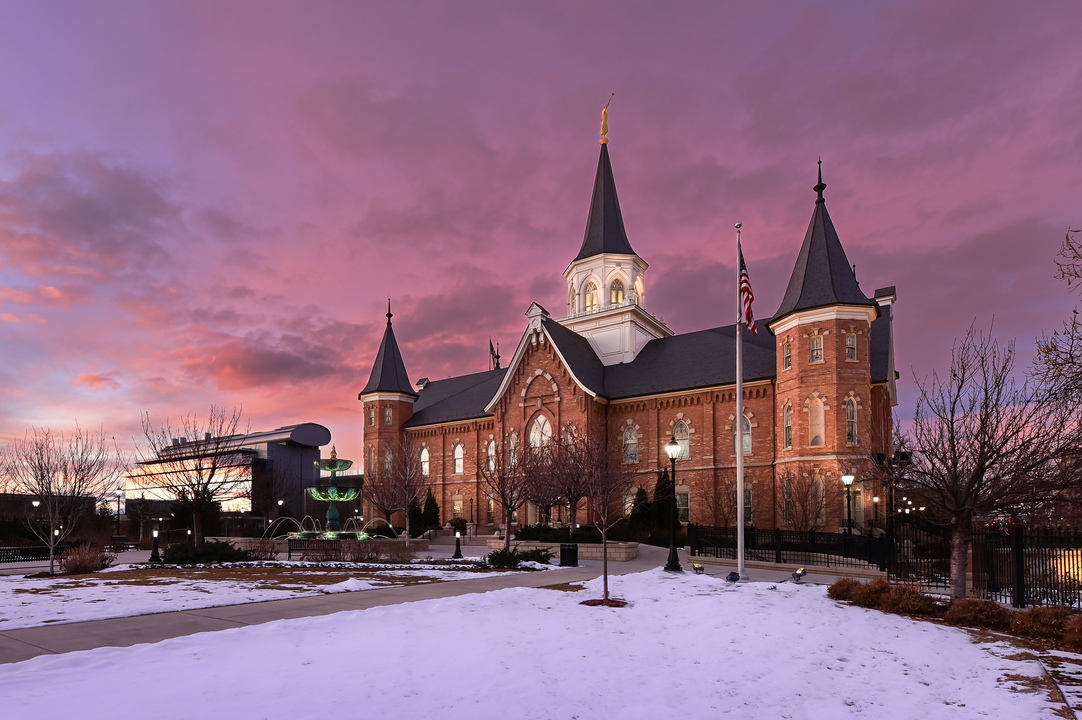
© Greg Farley. All rights reserved.
Services
Clothing rental availableNO cafeteria food served
NO patron housing available
NO distribution center nearby (Store Locator)
Announcement:
1 October 2011Groundbreaking and Site Dedication:
12 May 2012 by Jeffrey R. HollandPublic Open House:
15 January–5 March 2016Dedication:
20 March 2016 by Dallin H. OaksSite:
5.6 acres | 2.3 hectaresExterior Finish:
BrickArchitectural Features:
Central spire surrounded by four corner spires with an angel Moroni statueOrdinance Rooms:
Three instruction rooms (two-stage progressive), five sealing rooms, and one baptistryTotal Floor Area:
85,084 square feet | 7,905 square metersHeight:
150 feet | 45.7 metersElevation:
4,547 feet | 1,386 metersTemple Locale
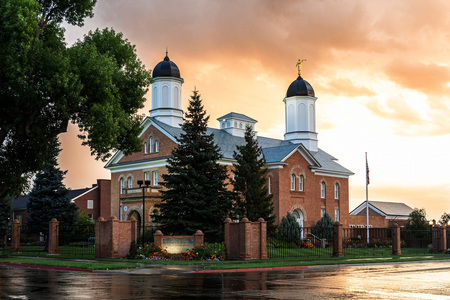
The stunning Provo City Center Temple stands in the heart of Provo's Central Business District on University Avenue between Center Street and 200 South. It is a meticulous preservation and amplification of the former Provo Tabernacle, which was built in the 1880s and ravaged by an accidental fire in 2010. The landmark temple restores the heritage of the tabernacle while magnifying the historic vision of the pioneers to create a Victorian masterpiece. A charming pavilion with a full basement stands on the temple grounds, providing a waiting area for non-temple patrons and a photograph-taking venue for wedding parties. The expansive landscaped grounds provide beautiful gathering and contemplation spaces.
Temple Facts
The Provo City Center Temple was the sixteenth temple built in the state of Utah, the fourth built in Utah County, and the second built in the city of Provo, following the Provo Utah Temple (1972).
The Provo City Center Temple was the fourth temple built from an existing building and the second built from a tabernacle, following the Vernal Utah Temple (1997).
The Provo City Center Temple was the second temple built in the same city as another operating temple, the Provo Utah Temple (1972), making Provo, Utah, the second city in the world to have more than one temple, following South Jordan, Utah.
Temple History
Background
The history of the city of Provo began in September 1849, when President Brigham Young and his counselors headed a small caravan from Fort Utah to find a location to start a city. The center block of the planned mile-square city would be reserved for a chapel and schoolhouse. This "Public Square" was marked at present-day Pioneer Park, located at Center Street and 500 West. However, conflicts and disagreements combined with a lack of building materials slowed work on the meetinghouse. A foundation had been laid by 1856, but Brigham Young advocated abandonment of the project and moved Provo's center five blocks east to the current grounds of the Provo City Center Temple.
"The Old Tabernacle," a building of timber, adobe, and stone that faced Center Street, was completed in 1861 and razed in 1919. Brigham Young dedicated the facility in 1867, publicly acknowledging that it "was entirely too small." Work on the new tabernacle began in 1883 under the direction of President John Taylor. By 1885, the $100,000 building was in use and even hosted the 1886 and 1887 general conferences. The edifice was finally dedicated in 1898. The tabernacle was built with seating for 1,500 and featured a brick exterior, octagonal towers at all four corners, a high-pitched roof, frosted-glass windows, spiral staircases, and exquisite woodwork including a hand-carved rostrum. Over the years, the tabernacle was remodeled and refurbished, culminating in a rededication in September 1986. The tabernacle had hosted both presidents of the Church and presidents of the United States, the first being William H. Taft in 1909. It had been the venue for numerous and varied musical performances, school commencements and convocations, high-profile funerals, interfaith gatherings, and community patriotic events.1
Tabernacle Fire
After standing unharmed for 125 years, the Provo Tabernacle met tragedy on December 17, 2010, when a four-alarm fire, reported at 2:43 a.m., engulfed the building—ripping through wooden pews, organ pipes, a rented Fazioli piano, priceless pioneer craftsmanship, and original pieces of art. For hours, a crew of approximately 25 firefighters subdued flames and doused the building with water. Around 5:00 a.m., the roof began to collapse, giving way completely within the hour and dragging with it portions of the front parapet and wall. Crews were still drenching hot spots by mid-afternoon, but felt encouraged by the still-standing exterior walls. Tearful crowds gathered throughout the day, looking on in reverent dismay as black smoke billowed from the iconic edifice.2
After three and a half months of investigation, a 135-page report by the Provo Fire Department concluded that a series of human errors led to the merciless blaze that destroyed the interior of the Provo Tabernacle. The events were set into action when a lighting technician, making room for temporary stage lighting, removed two 300-watt light fixtures in the attic and set one on a wooden speaker box without removing the bulb. The night before the fire, the light came on with the rest of the house lights at 7:00 p.m. when performers arrived for a rehearsal of Lex de Azevedo's Gloria. The report estimated that the hot bulb ignited the speaker box by 9:30 p.m. and continued burning by the time everyone left at 11:00 p.m. Signs of a fire were passed off or mistaken by observers until a security guard at Nu Skin saw smoke coming from the tabernacle roof at 2:39 a.m. Fire dispatchers soon received a call.3
Perhaps the most remarkable discovery made among the ashes the day after the fire was a giclee print of The Second Coming by Harry Anderson, which depicts Jesus Christ coming through the clouds with heralding angels on either side—a picture frequently featured in Latter-day Saint temples. The tabernacle painting, which sat inside the east front door, was completely blackened by residual fire except for the untouched figure of Jesus Christ himself with hands outstretched. Those who saw the painting in person were awestruck. Officials directed the print to be removed immediately for conservation and stabilization. It was handled with the greatest care, wrapped in plastic, and loaded into a waiting truck. The extraordinary occurrence was dubbed by some to be a "Christmas miracle."4
Temple Site
Rumors of the Provo City Center Temple began in August 2011 when news reports revealed the Church's acquisition of the Provo Travelodge Motel and Los 3 Amigos Restaurant, located on the block south of the burned-out shell of the Provo Tabernacle. On September 27, 2011, the third of four properties on the block were secured when the Provo City Council, acting as the Redevelopment Agency Board, voted unanimously to sign a letter of intent with the Church to sell the site of the old Hotel Roberts. The Howard C. Nielson Post Office stood on the final tract, which was not for sale, though the Church had expressed interest in acquiring it.5 NuSkin International later sold its parking terrace to the Church, located west of the temple, since a replacement facility has been constructed further west.
Announcement
On October 1, 2011, during his opening remarks at the Saturday morning session of the 181st Semiannual General Conference, President Thomas S. Monson began his temple announcements by stating, "First, may I mention that no Church-built facility is more important than a temple. Temples are places where relationships are sealed together to last through the eternities. We are grateful for all the many temples across the world and for the blessing they are in the lives of our members." He then announced that the Provo Tabernacle, which had been devastated by fire the previous December, would be rebuilt as a second temple for the city of Provo.6
A gasp of surprise filled the Conference Center after the announcement, and in Provo, it wasn't long before joyful members filled the streets near the historic building flashing cameras and smiles. "We're so happy," said Orem resident Kay Davenport. "We are going to have two temples in the city."7
Archaeology
On March 31, 2012, the archaeology team that excavated and documented the foundation of the Old Provo Tabernacle completed its work. It was announced that the foundation would be removed with a large portion of the stone being donated to the City of Provo. "We're very excited about this announcement," said city spokeswoman Helen Anderson. "There are several ways it can be integrated into using it for our pioneer heritage."8
By the end of April 2012, removal of the foundation of the Old Provo Tabernacle was completed. The limestone foundational walls were built four feet thick and up to five feet deep. The excavated stone was donated to the City of Provo for use in community projects. Artifacts from the archaeological dig went on display in an exhibit at Brigham Young University's Museum of People and Cultures. Rich Talbot, director of the Office of Public Archaeology at BYU, said, "Construction of the Provo City Center Temple will require that the southern portion of the old Provo Tabernacle be removed. The northern portion will be covered over to protect and preserve it. If at some point the Church wants to incorporate that portion of the structure into the landscaping, it could then be uncovered and stabilized."9
In early November 2012, the earliest known baptistry of the Church in Utah County was discovered on the site of the Provo City Center Temple. The five-by-nine-foot font was built around 1875 and used until 1906 or so. It had three layers of wood laid in crisscross fashion, fastened by nails and screws. A water pipe to fill and drain the font were also discovered. Large quantities of painted plaster fragments were found, revealing the original sky blue color of the interior walls.
Groundbreaking
On Saturday, May 12, 2012, ground was broken for the Provo City Center Temple in a ceremony presided by Elder Jeffrey R. Holland of the Quorum of the Twelve. "What an absolute stunning site!" said Elder Holland. He confessed to being deeply touched by the occasion. "You can tell people Elder Holland was downright giddy today about the temple groundbreaking." After the Provo Tabernacle was tragically lost to fire, Church leaders contemplated the future of the building's empty shell and spires, and a decision was reached. "It is inspired to build a temple out of the ashes of the tabernacle," said Elder Holland. Having two temples within miles of each other is a "tribute to you that the Brethren would approve another temple here. That says very much about you."10
Angel Moroni
On Monday, March 31, 2014, thousands of spectators gathered around the Provo City Center Temple to witness the moment when the 13-foot statue of the angel Moroni was placed atop the 160-foot central tower. The highly anticipated event began at 2:30 p.m. with crowds gathering at a variety of locations.11
Open House
A seven-week public open house was held for the Provo City Center Temple from January 15 through March 5, 2016, providing the opportunity for more than 800,000 people to tour the interior of the building before it was dedicated.
Cultural Celebration
On Saturday, March 19, 2016, approximately 4,500 Latter-day Saint youth gathered in Brigham Young University's Marriott Center for a cultural celebration that presented the history of the Church in Utah through music and dance. "I am thrilled to be with you," said Elder Dallin H. Oaks, a former president of Brigham Young University. After reminiscing about the many events he had attended over the years in the Marriott Center, he said, "Now we add to that great list of occasions our gathering here for this cultural celebration preceding the dedication of the Provo City Center Temple."
Dedication
Elder Dallin H. Oaks of the Quorum of the Twelve Apostles dedicated the Provo City Center Temple in three sessions held on Sunday, March 20, 2016. It was the 150th dedicated temple in operation in the world. In his dedicatory prayer, he gave gratitude for Utah Valley saying, "We thank Thee for all of the righteous activities and occupations Thou hast caused to be established in this blessed valley, including the educational efforts of Brigham Young University, Utah Valley University, and Thy missionary training center. We pray that Thou wilt bless all of these in their efforts to enlighten and motivate Thy children in Thy service."
Temple Design
The Provo City Center Temple recaptured the historic beauty of the former Provo Tabernacle through meticulous preservation and careful study of the design of the original structure. Interior components that survived the fire including wood moldings, newel posts, and balustrades, were used as models for the production of rich woodwork and other design elements used throughout the temple.
The temple consists of four levels—two above ground and two below. The lower levels house the baptistry, dressing rooms, offices, and bride's room with a large skylight while the upper levels house the chapel, endowment rooms, sealing rooms, lobbies, and additional offices. The main entrances to the temple are on the south side near the 50-car surface parking lot and through the 245-car underground parking area. Both lots are accessible from 200 South and 100 West.
Landscaping around the temple is extensive, bringing lush flower gardens, trees, and greenspace to downtown Provo. The public gardens and benches on the north side of the property are open 24 hours a day, seven days a week. Fences topped with beehives surround the temple—both a lower ungated fence around the perimeter of the property and a taller gated fence around the temple proper. Scalloped shingles, matching the original 1800s design, were placed on the roof. Special features include a magnificent 17-foot, four-tiered bronze Victorian fountain with ornamental nozzles and a finial cast in the style of a newel post from the tabernacle. There is also a 5,290-square-foot, two-story Victorian pavilion (one story above ground, one below) about halfway between 100 and 200 South—connected by an elevator to the underground parking area—which provides a waiting area for non-temple patrons and a photograph-taking venue for wedding parties.12
The exterior of the temple reflects the original design of the Provo Tabernacle, which featured a magnificent 147-foot central tower. Bishop John P. R. Johnson and others opposed the tower at the time of the tabernacle's construction, cautioning that it would place too much stress on the building. Over thirty years later, that advice was finally heeded when it became apparent that the roof could not bear the weight of the tower in the long term. The building was partially condemned in 1913. Then, as part of a 1917 remodel, which included replacement of the frosted glass windows with stained art glass windows, the tower came down—followed by the supporting platform in the 1950s. In 1964, plans to raze the tabernacle were entertained to make way for a commercial development and a new multistake facility built elsewhere. In the end, however, the decision was made to improve the grounds and facility, allowing it to better fulfill its purpose.13
Temple Approval
On March 14, 2012, the Provo City Planning Commission heard a request from the City to vacate a portion of 100 South—the road running between the Provo City Center Temple and the Church's recently acquired property to the south. The Commission unanimously recommended approval so that the property could be sold to the Church for its temple campus.
On April 17, 2012, the Provo Municipal Council unanimously approved an ordinance to vacate Provo City Corporation's property interest in 100 South between University Avenue and 100 West. A study examining the effect of closing 100 South to traffic found that traffic flow would improve in downtown Provo.
On May 1, 2012, the Provo Municipal Council unanimously voted to surplus 0.447 acres of 100 South between University Avenue and the west end of the Provo Tabernacle. Once fair market value had been established for the property, the City would sell to the Church. The portion of the street in front of the post office and NuSkin parking terrace was not part of the sale so that access to those structures would remain the same.
On October 30, 2012, another portion of 100 South was added to the City of Provo's surplus property list, in preparation for selling the parcel to the Church. The land was adjacent to the NuSkin parking terrace, which had been recently acquired by the Church and would be demolished in the spring of 2013. The eventual acquisition of the post office by the Church seemed inescapable, but the disposition of the post office was to not sell.14
- Scott Taylor, "Provo Tabernacle remembered for its past?and presence," Deseret News 17 Dec. 2010.
- Donald W. Meyers, Kristen Moulton, and Bob Mims, "Provo's cultural heart broken by Tabernacle fire," Salt Lake Tribune 17 Dec. 2010.
- Dennis Romboy, "Report: Light fixture, human error caused Provo Tabernacle fire," Deseret News 31 Mar. 2011.
- Caleb Warnock, "Scorched portrait of Christ saved from Tabernacle," Daily Herald 18 Dec. 2010.
- Derek P. Jensen, "Provo selling more land near tabernacle to LDS Church," Salt Lake Tribune 28 Sept. 2011.
- The Church of Jesus Christ of Latter-day Saints News Release, "New Temples Announced for France, Africa, Colombia, Utah and Wyoming," 1 Oct. 2011.
- The Church of Jesus Christ of Latter-day Saints News Release, "New Temples Announced for France, Africa, Colombia, Utah and Wyoming," 1 Oct. 2011.
- Genelle Pugmire, "Tabernacle dig ending Friday in anticipation of groundbreaking," Daily Herald 28 Mar. 2012.
- Ryan Morgenegg, "Provo Tabernacle excavation: Work completed!," Church News 28 Apr. 2012.
- The Church of Jesus Christ of Latter-day Saints News Release, "Ground Broken for Provo, Utah's Second Temple," 12 May 2012.
- "Angel Moroni Now Tops The Provo City Center Temple," The Church of Jesus Christ of Latter-day Saints News Release, 31 Mar. 2014.
- Genelle Pugmire, "LDS Church: New Provo temple to stay true to historic roots," Daily Herald 26 Jan. 2013.
- "The Provo Tabernacle's Remodeling Phases," Historic Provo Tabernacle 2 Oct. 2011.
- Genelle Pugmire, "City surpluses property before planned sale to LDS Church," Daily Herald 31 Oct. 2012.