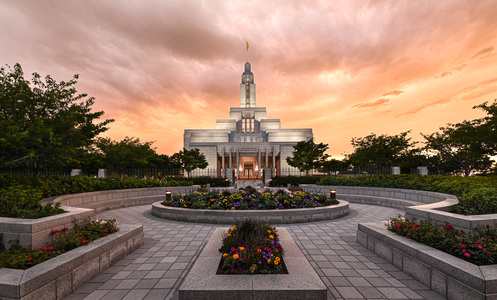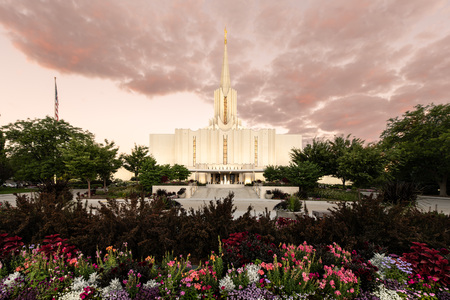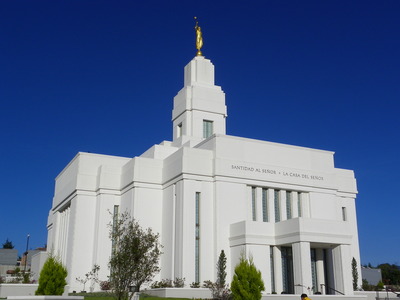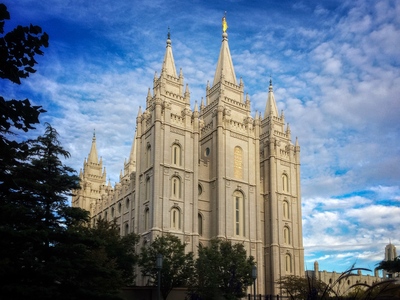
Draper Utah Temple
Vancouver British Columbia Temple
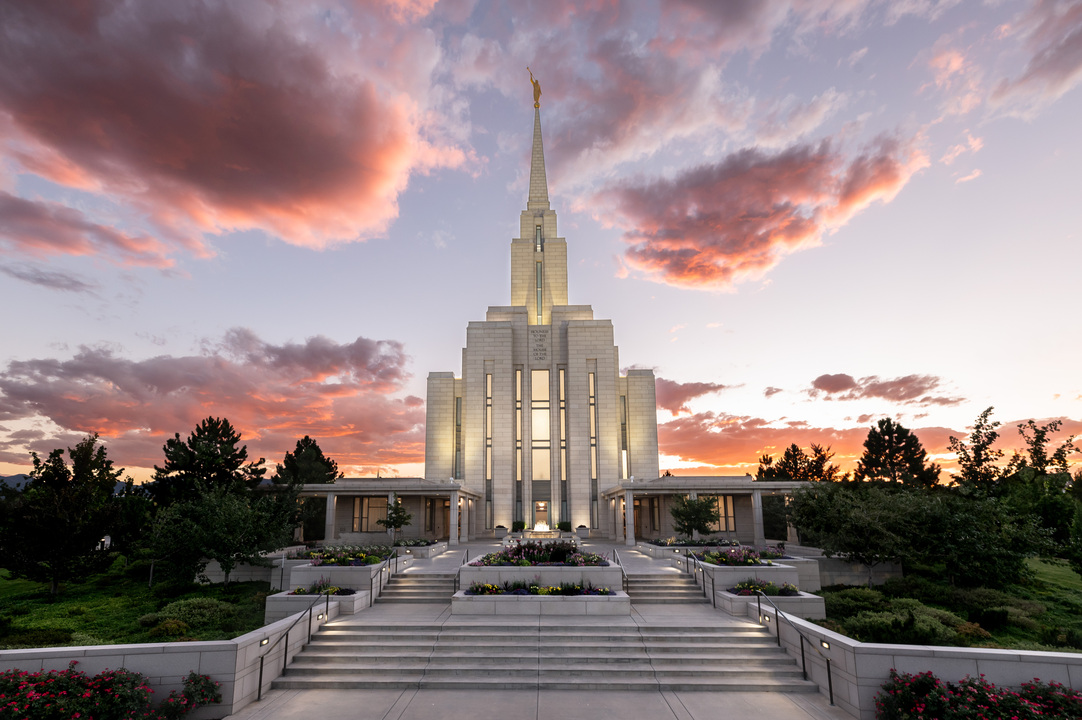
Oquirrh Mountain Utah Temple
130th dedicated temple in operation
© Greg Farley. All rights reserved.
Services
Clothing rental availableNO cafeteria food served
NO patron housing available
NO distribution center nearby (Store Locator)
Announcement:
1 October 2005Groundbreaking and Site Dedication:
16 December 2006 by Gordon B. HinckleyPublic Open House:
1 June–1 August 2009Dedication:
21–23 August 2009 by Thomas S. MonsonSite:
11 acres | 4.5 hectaresExterior Finish:
Uinta Gold Granite from ChinaArchitectural Features:
Single attached end spire with an angel Moroni statueOrdinance Rooms:
Four instruction rooms (two-stage progressive), seven sealing rooms, and one baptistryTotal Floor Area:
60,000 square feet | 5,574 square metersHeight:
183 feet | 55.8 metersElevation:
4,783 feet | 1,458 metersTemple Locale
Standing on a beautiful bluff just west of highly traveled Bangerter Highway, the Oquirrh Mountain Utah Temple sits at the foot of the Oquirrh (pronounced O'-ker) Mountains, facing east toward a panoramic view of the Wasatch Mountains and the valley's other three temples: the Salt Lake Temple, Jordan River Utah Temple, and Draper Utah Temple. Lined with walkways, the picturesque temple grounds are open to the public for strolls around this magnificent House of the Lord. An adjacent meetinghouse welcomes visitors for worship services on Sundays.
Temple Facts
The Oquirrh Mountain Utah Temple was the thirteenth temple built in Utah and the fourth built in the Salt Lake Valley, following the Salt Lake Temple (1893), the Jordan River Utah Temple (1981), and the Draper Utah Temple (2009).
The Oquirrh Mountain Utah Temple was the first temple built in the same city as another operating temple, the Jordan River Utah Temple (1981), making South Jordan, Utah, the first city in the world to have more than one temple.
During the groundbreaking ceremony for the Oquirrh Mountain Utah Temple, President Gordon B. Hinckley announced plans to construct the Quetzaltenango Guatemala Temple.
Until the groundbreaking ceremony, the Oquirrh Mountain Utah Temple had been unofficially named the South Jordan Utah Temple. However, to avoid confusion with the Jordan River Utah Temple, the official name was chosen to reflect the Oquirrh Mountain range.
The spire of the Oquirrh Mountain Utah Temple was installed atop the temple on July 11, 2008, immediately followed by installation of a gold-leafed statue of the angel Moroni.
Lightning struck the angel Moroni statue atop the Oquirrh Mountain Utah Temple on Saturday afternoon, June 13, 2009, during the public open house. The powerful bolt of lightning blackened Moroni's trumpet, arm, and face. A replacement statue was installed on August 11, 2009, 10 days before the dedicatory services began.
The ordinance room murals in the Oquirrh Mountain Utah Temple were painted by artists who were called as "art missionaries" for the Church.
President Thomas S. Monson dedicated the Oquirrh Mountain Utah Temple on his 82nd birthday. The crowd gathered for the cornerstone ceremony spontaneously sang him a birthday song.
For the first time in Utah's history, church was cancelled statewide on August 23, 2009, to allow members to attend the dedication of the Oquirrh Mountain Utah Temple without conflict.
Temple History
Announcement
In his opening remarks of General Conference, held October 1, 2005, President Gordon B. Hinckley announced plans for the Oquirrh Mountain Utah Temple, the fourth in the Salt Lake Valley. He also noted that a site had been acquired for a fifth Salt-Lake-area temple in the southwest part of the valley, which has been set aside for a future announcement.1
Approval
On Tuesday, November 28, 2006, the South Jordan Planning Commission wholeheartly approved plans for the temple, which drew rave reviews from city staff and zero public comment.2 Plans called for a 60,000-square-foot building with 63-foot high walls and a single spire reaching 183 feet heavenward, topped by the traditional gold-leafed angel Moroni statue.3
Groundbreaking
On December 16, 2006, President Hinckley presided at the groundbreaking ceremony where he announced the official name of the temple as the Oquirrh Mountain Utah Temple. It has been previously called the South Jordan Utah Temple. The beautiful Oquirrh Mountains form the western boundary of the Salt Lake Valley.4
Temple Design
Exterior
- Exterior stone: Uinta Gold Granite from the Quanzhou/Xiamen area, China.
- Pavers: Wyndam Grey Granite from the Qingdao area of Northern China.
- Art glass: Brilliant Cut by John Quist, Salt Lake City, Utah, featuring stars, circles & flutes.
Interior
- Interior stone: Light limestone from Morocco and darker limestone from Egypt.
- Woods: Rift-cut White Oak solids from Indiana and Kentucky. Veneers: White Oak (doors) and Sycamore from German Alps.
- Chandeliers: Schonebek with Swarovski Crystal (Celestial Room chandelier is 15 feet tall with 19,447 individual crystals)
- Bronze handrails: Julius Blum components forged in the United States.
- Original murals: Painted by Church-service missionaries, supervised by Linda Curley Christensen.
- The Church of Jesus Christ of Latter-day Saints News Release, "New Salt Lake Valley Temple Announced," 1 Oct. 2005.
- Jared Page and Carrie Moore, "S. Jordan planners OK temple," Deseret News 1 Dec. 2006.
- Jared Page and Carrie Moore, "S. Jordan planners OK temple," Deseret News 1 Dec. 2006.
- The Church of Jesus Christ of Latter-day Saints News Release, "Groundbreaking Held for Oquirrh Mountain Utah Temple," 16 Dec. 2006.